
eyetec at A3P Visual Inspection Forum 2026
Lyon, November 25-26, 2026
Join our three hands-on workshops on AVI implementation, PoD studies and particle identification. All workshops are open to every A3P attendee. No registration needed, just walk in.
Or stop by booth 9 to talk through the inspection question on your desk. Book a meeting at booth 9
Automated Visual Inspection in Practice: how early decisions shape project succe
Wednesday, November 25, 5:00 PM | 1 hour
Gunther Coenen, Operations Director, and Bram Keymolen, Compliance Director
All three workshops are open to every A3P attendee. No registration needed, just walk in.
The success of an AVI project depends not only on the machine itself. It also depends on the decisions made during preparation: product knowledge, defect definitions, the MVI baseline, risk assessment, feasibility testing, test set design and qualification strategy.
What you will do
In small teams, you work through a fictional AVI project. You define the key implementation steps, identify the main risks and discuss how typical complications can affect timelines, false reject rates, qualification and routine production.
Key takeaway
AVI implementation is not only about proving that the machine works. It is about building the right inspection strategy before the machine is qualified.
PoD in practice: understanding results and improving your study
Thursday, November 26, 9:30 AM | 1 hour
Basma Barakat, Project Scientist Visual Inspection & CCIT, and Bram Keymolen, Compliance Director
Probability of Detection (PoD) studies show how consistently an inspection method detects defects. Useful results depend on careful choices in how you design and run the study.
What you will do
Using a fictional dataset, you calculate PoD values for manual visual inspection and compare results across units and operators. You then weigh different combinations of operators and runs against reliability, available time and fatigue.
Key takeaway
Useful PoD results depend on the study design behind the calculation. A representative test set, suitably trained operators and controlled inspection conditions help you produce results that support real improvements.
Particle identification in visual inspection investigations
Thursday, November 26, 12:15 PM | 1 hour
Karlijn Cornelissen, CQ Specialist, and Bram Keymolen, Compliance Director
Particle identification can move an investigation from visual assumptions toward material evidence. This session follows the practical flow from particle isolation and optical microscopy to FTIR and SEM/EDX analysis, including the comparison with reference materials from your own production environment.
What you will do
You review example particle cases with FTIR and SEM/EDX outputs. For each case, you vote on the most likely material or source, and discuss what information is missing and which follow-up steps make sense for your investigation, PSRA review, CCS update or CAPA.
Key takeaway
Particle identification supports a more focused investigation, but results should always be interpreted together with process knowledge and investigation context.
Times are indicative and subject to changes in the A3P program.
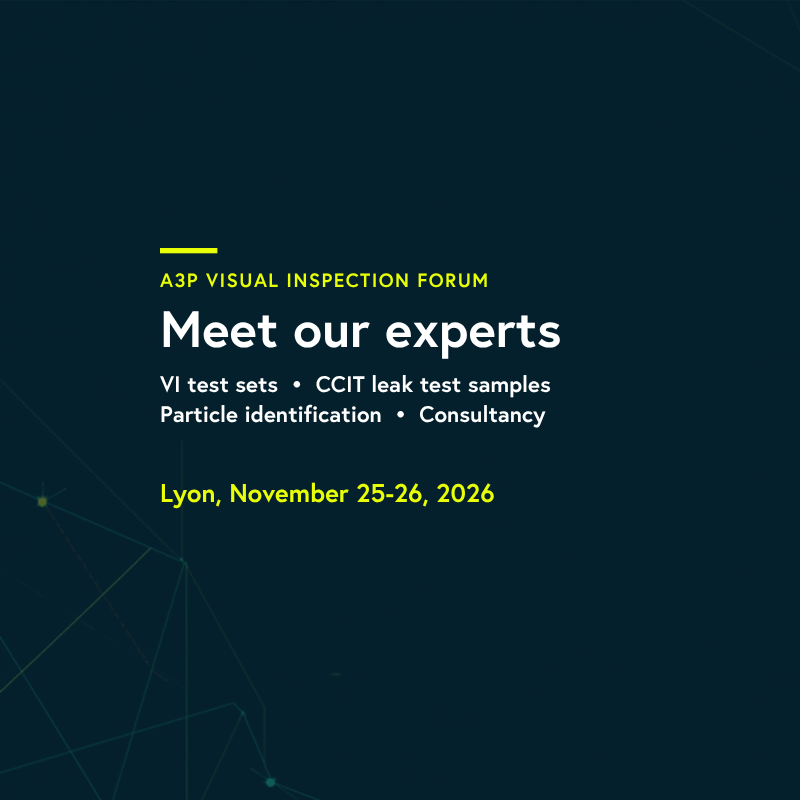
Meet us at booth 9
Bring the inspection question on your desk. Our team covers visual inspection, CCIT and compliance engineering:
- VI test sets: your product, your container, your defects, for MVI and AVI
- CCIT leak test samples: positive controls for your container closure integrity testing
- Particle identification: from isolation to FTIR and SEM/EDX
- Consultancy: from URS to reliable routine inspection, including PoD studies and MVI training
We bring a unique combination of production, engineering, and compliance expertise.